Commercial Floor Sanding in Acton, W3
Commercial timber floors in Acton take a different level of punishment from a domestic floor. Shops around Acton High Street and Churchfield Road deal with tracked-in grit and constant footfall; offices and studios suffer chair-wheel abrasion; pubs, cafés and restaurants see water, grease and cleaning chemicals breaking down the lacquer long before the timber itself has reached the end of its working life.
We carry out commercial floor sanding in Acton, W3 for occupied and vacant premises, including private offices, coworking and serviced offices, retail units, restaurants, pubs, workshops, warehouses, gyms, studios, hotels, clinics, schools and places of worship. Where sanding alone is not enough, our work can form part of a wider Commercial Floor Restoration in Acton programme covering timber repairs, re-bonding, gap filling, finishing and planned aftercare.
The object is not simply to make the boards look cleaner. A commercial floor has to be stable, maintainable and fit-for-purpose once staff, customers, trolleys, dining chairs or equipment are back on it, which is why we also advise on Commercial Floor maintenance in Acton and, where the existing finish can be retained, Commercial Floor Polishing in Acton rather than unnecessarily removing timber.

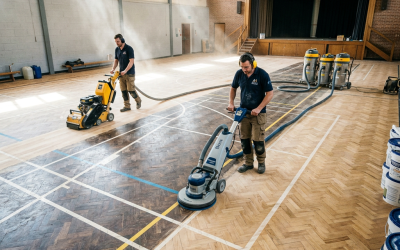
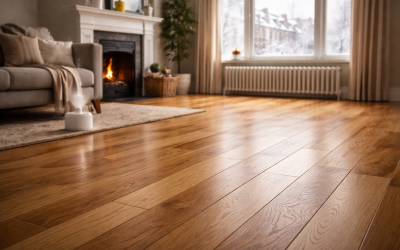
Before and after herringbone parquet floor restoration in a commercial restaurant and bar space in Acton W3, showing the worn timber floor transformed after professional sanding and refinishing.
Commercial Floor Problems We See Across Acton, W3
Acton has an awkward mix of old and new buildings from a flooring point of view. Around the High Street, Market Place, Horn Lane and Churchfield Road there are Victorian and Edwardian commercial buildings, converted upper-floor offices, civic and institutional premises, alongside later retail units and modern mixed-use developments.
Older buildings often contain suspended pitch-pine boards, narrow oak strip, parquet blocks or floors that have been patched several times during alterations. In later offices, gyms and retail premises we more commonly find engineered oak, modern parquet or timber laid over screeded concrete, where moisture readings and adhesive condition become just as important as the sanding itself.
We also work around the wider W3 commercial catchment towards East Acton, North Acton and the Park Royal side of the district. These premises frequently present a different problem: heavier loading, loading-bay contamination, wheeled traffic, partition changes and large open floor plates that need to remain operational while work is phased.
Why domestic sanding methods are not enough
A small domestic machine, light abrasive sequence and single-pack varnish may look acceptable when the floor is handed over, but that specification can fail very quickly under commercial use. A restaurant aisle, reception area or shop entrance can receive more abrasion in a few weeks than a bedroom floor receives in years.
Off-the-shelf polish also causes trouble when it is applied over degraded polyurethane, silicone-contaminated cleaning residues or old wax. Instead of bonding properly it can create patchy gloss, soft films or a surface that becomes unpredictable when wet.
- Open board and parquet gaps: collect food debris, grit and cleaning moisture and can become hygiene traps in cafés, clinics and hospitality premises.
- Loose parquet blocks: move under point loading and can fracture neighbouring tongues or blocks if they are sanded before being re-bonded.
- Raised nail heads and fixings: damage sanding drums and may create local high spots or trip hazards.
- Moisture ingress: can cause cupping, edge lift, adhesive failure or staining, particularly above ground-floor slabs and around entrances.
- Worn entrance zones: lose coating faster because grit acts as an abrasive under footwear.
- Unsuitable coatings: may not provide the required wear resistance, chemical resistance or slip characteristics for the intended use.
- Previous aggressive sanding: can leave parquet thin at the tongue or reduce old floorboards to the point where another heavy cut would be irresponsible.
- Cleaning-chemical damage: alkaline degreasers, alcohol products and repeated wet mopping can soften or whiten unsuitable finishes.
Our Commercial Timber Floor Restoration Process
Every commercial job is approached as a flooring project rather than a simple sanding booking. Before machinery is brought onto site we establish what the floor is, what is underneath it, how the premises operate and how quickly the area has to return to service.
Step 1: Subfloor Audit & Moisture Testing
The first job is identification. Quartersawn oak behaves differently from soft pitch pine, teak can contain natural oils that affect coating adhesion, and an engineered board has a limited wear layer that cannot be treated like a 22 mm solid block floor.
We inspect movement, hollow areas, previous repairs, remaining timber thickness, expansion provision and signs of moisture stress. On timber fitted over screeded or concrete substrates, hygrometer checks or other appropriate moisture testing are carried out where the condition of the floor suggests a moisture risk.
Sanding a damp or actively moving floor is wasted money. If moisture is entering from a slab, leaking service, threshold or cleaning regime, that cause needs identifying before a new coating system is specified.
For managed commercial sites we can work to site-specific RAMS documentation, with relevant COSHH information covering coatings, fillers, adhesives and the wood dust generated during mechanical sanding. Wood dust is a substance that requires proper exposure control, so extraction and housekeeping are treated as part of the work rather than an optional extra.
Step 2: Timber Repairs, Re-bonding & Resin Gap-Filling
Loose parquet is repaired before the main sanding sequence. Where appropriate, individual blocks are lifted, old brittle adhesive is removed and the blocks are re-bonded with a suitable flexible parquet adhesive; on compatible specifications we favour modern silane-based products because they retain useful elasticity without leaving the floor rigidly locked to the substrate.
Products can also be selected with recognised low-emission classifications such as EMICODE EC1 Plus where indoor air quality, occupied offices, schools, clinics or accommodation are a concern. Material choice still depends on the substrate, timber species and expected duty rather than an environmental label alone.
Damaged floorboards can be pieced in with matching reclaimed or new timber where available. We pay attention to species, width, thickness and grain because a random softwood patch in an old pitch-pine floor will stain and wear differently from the surrounding boards.
Fine, stable gaps in parquet or strip flooring can often be treated with a resin-slurry system using clean sanding dust from the floor. Wide seasonal board gaps are assessed differently; packing or local timber repairs may be more suitable because rigidly filling a moving suspended floor can result in the filler cracking out during seasonal movement.
Step 3: HEPA Dust-Controlled Sanding & Surface Preparation
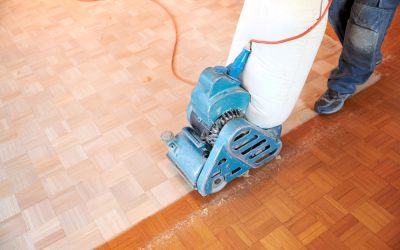
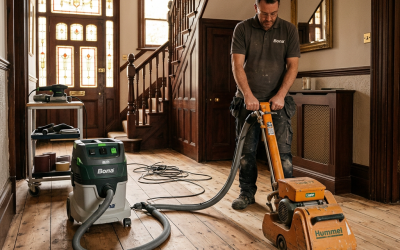
For serious floor removal we use professional belt-sanding equipment such as the Lägler Hummel rather than lightweight hire-centre machinery. The Hummel has the cutting power and tracking accuracy needed to flatten commercial wear patterns without endlessly passing over the same timber.
Abrasive selection is governed by the existing finish and floor condition. Heavy aluminium-oxide lacquer may need an assertive opening grade, while a relatively level engineered oak floor may only need controlled finishing cuts so the wear layer is preserved.
Edges, radiator lines, thresholds and areas beneath fixed joinery are worked separately, then the field is refined through progressively finer abrasives. Skipping too many grades leaves deep belt marks that become far more visible when a clear 2K lacquer is applied.
Dust extraction is connected at source and, where the site specification calls for enhanced containment, HEPA H14 filtration can be incorporated into the dust-control arrangement. That matters in clinics, schools, offices, hospitality premises and live commercial buildings where dust migration into ventilation systems, stock, electronics or adjacent occupied rooms is unacceptable.

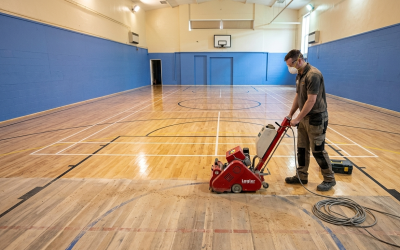
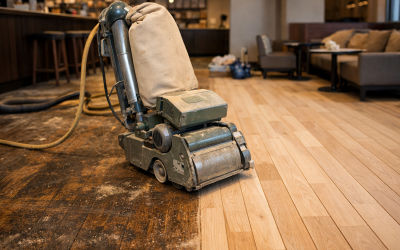
Professional commercial floor sanding in Acton W3, restoring worn wooden flooring to a smooth, clean finish.
Step 4: High-Traffic Finishes
The coating system is chosen after we understand how the floor will actually be used. A dry private office, busy pub entrance, treatment room and gym studio should not automatically receive the same product simply because they all contain oak.
For demanding commercial areas we commonly specify professional 2K waterborne polyurethane systems. The cross-linking catalyst increases chemical and wear resistance compared with basic single-pack domestic lacquers, while modern waterborne systems avoid the heavy solvent loading associated with older commercial coatings.
Matt and extra-matt finishes are often sensible in offices and heritage interiors because they disguise minor traffic marking better than high-gloss lacquer. In retail and hospitality, sheen level is agreed against lighting, cleaning routine, design intent and expected wear.
Hardwax oils remain useful where localised repairability and a more natural appearance matter, but they require a proper maintenance plan. A hardwax-oiled restaurant floor that is repeatedly degreased with the wrong alkaline cleaner will deteriorate quickly regardless of how well it was sanded.
Where slip performance is part of the specification, we can discuss finishes designed to increase slip resistance and the need for formal testing. Pendulum testing to the BS 7976-2 methodology remains a recognised means of assessing pedestrian slip resistance, but the required specification should be agreed for the actual environment and contamination risk rather than relying on vague claims that a coating is simply “non-slip”.

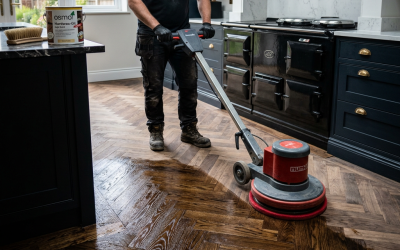
Professional varnishing of a commercial parquet floor in Acton W3 using a roller applicator
Step 5: Cure Times, Reopening & Maintenance Protocols
Dry to touch is not the same as fully cured. Depending on the lacquer system, temperature, humidity and airflow, a floor may accept careful foot traffic before it is ready for furniture loading, rolling chairs, rugs, wet cleaning or heavy commercial use.
We build those cure windows into the programme before work starts. There is little point finishing a shop at 5am if staff drag shelving across uncured lacquer at 7am and damage a coating that would otherwise have performed for years.
The handover can include guidance on entrance matting, pH-appropriate cleaning products, damp-mopping rather than flooding, felt protection, chair castors and periodic maintenance coats. Planned commercial floor maintenance in Acton normally costs far less than repeatedly allowing the protective film to wear through to bare timber.
Commercial Floor Sanding for Different Acton Premises
Offices, Coworking Spaces & Serviced Offices
Office floors tend to wear heavily at reception points, tea stations, lift approaches and beneath wheeled task chairs. We can phase sanding around desks, meeting rooms and shared circulation routes so an occupied office does not always have to close as one large work zone.
Shops, Boutiques, Showrooms & Shopping-Centre Units
Retail programmes are usually dictated by trading hours and merchandising. Night-shift sanding and controlled overnight coating can be considered where the chosen finish allows it, with particular attention paid to entrances where moisture and pavement grit accelerate coating failure.
Restaurants, Cafés, Pubs & Takeaway Units
Hospitality timber floors require careful degreasing and contamination checks before sanding. Oils, beer, cleaning chemicals and food fats can penetrate exposed joints and affect both fillers and subsequent finishes, especially around bars, service counters and kitchen thresholds.
Factories, Workshops & Manufacturing Units
In workshop environments we establish whether timber is genuinely the correct retained surface for the operational load. Where restoration is appropriate, machinery routes, point loading, oil contamination and local repair requirements are dealt with before cosmetic appearance.
Storage Units, Distribution Centres & Delivery Depots
Timber in logistics premises is frequently damaged by trolleys, pallet movement and grit rather than normal footwear. Sectional working may allow access routes and loading operations to continue while isolated timber areas are restored.
Gyms, Cinemas, Event Venues & Studios
Studios and event spaces need consistent surface texture and predictable maintenance characteristics. Gyms may also require closer attention to sweat, cleaning products, matting, impact loads and slip risk, depending on how each room is used.
Hotels, Hostels & Serviced Accommodation
Corridors, reception areas and communal rooms often have narrow shutdown windows. We can discuss phased room blocks and out-of-hours work so access, housekeeping and guest circulation remain manageable.
Clinics, Dental Practices & Treatment Rooms
Dust control, low-emission products and cleanable joint details are particularly important in healthcare settings. We can specify low-VOC compatible adhesives and finishes where appropriate, while coordinating work around treatment hours and reopening requirements.
Schools, Colleges, Universities & Academies
Educational floors often combine very old timber with high footfall and limited maintenance periods. Holiday work, weekend phasing and documented site controls make it possible to deal properly with assembly halls, teaching rooms, libraries and administrative areas rather than rushing the work between occupied sessions.
Churches, Mosques & Temples
Places of worship can contain anything from old suspended softwood to oak parquet and later replacement sections. Programming needs to respect services, prayer times, community use and events, while the finish must cope with concentrated footfall and regular cleaning.
Working Around Active Commercial Premises
A commercial sanding programme is often won or lost on logistics rather than machine speed. We agree access, noise restrictions, alarm procedures, isolations, loading arrangements, waste handling and reopening times before the main work begins.
| Working Method | Operational Benefit | Typical Facility Suitability |
|---|---|---|
| Overnight Shift | Allows noisy sanding and initial coating work after customers and staff have left. Useful where daytime closure would affect turnover. | Shops, restaurants, pubs, offices, clinics, studios and public-facing premises. |
| Weekend Phased | Provides a longer uninterrupted curing window and reduces interference with weekday operations. | Offices, schools, colleges, dental practices, showrooms and commercial administration buildings. |
| Sectional Working | Keeps part of a large premises accessible while another section is repaired, sanded and coated. | Warehouses, coworking floors, hotels, event venues, factories and larger retail units. |

Before and after restoration of original pine floorboards in a commercial hall or function room in Acton W3, showing the worn timber floor before sanding and the polished finished floor after restoration.
Health, Safety & Commercial Site Documentation
Commercial flooring work involves machinery, electrical leads, airborne wood dust, chemical products and temporary loss of normal access routes. Site controls therefore need to reflect the premises rather than relying on a generic domestic risk assessment.
Where required, the project documentation can include RAMS, COSHH assessments and product safety information for lacquers, primers, fillers and adhesives. Work zones can be segregated from staff or public access, with extraction, cable management and housekeeping planned around the site.
HSE guidance specifically identifies sanding wood with power tools as a process capable of producing significant wood-dust exposure. Effective on-tool extraction and suitable filtration are consequently part of professional dust control, not merely a way of reducing cleaning afterwards.
For areas where formal slip performance matters, the final finish can be selected with the intended use in mind and independent Pendulum testing arranged where the client, facilities manager or project specification requires measured evidence. Testing methodology should be appropriate to the surface condition and whether the practical risk is dry, wet or contaminated use.
Why Timber Identification Matters Before Sanding
We regularly see floors described simply as “wood” on specifications, but species and construction make a material difference. Old pitch pine can contain resin and previous treatments, oak contains tannins that react with certain contaminants, and teak has natural extractives that need to be considered when preparing for a new coating.
Quartersawn oak also presents differently from plain-sawn material, particularly after deep scratches and uneven historic sanding have been removed. Correct identification helps determine abrasive sequence, filler choice, stain behaviour and whether the requested colour is realistically achievable.
On engineered timber we also confirm the remaining wear layer wherever practical. Nobody benefits from making an engineered board look perfect for one handover if the sanding has taken the veneer dangerously close to the backing layer.
Acton Commercial Floor Repairs Before Full Replacement
Many worn commercial timber floors do not need replacing. If the boards or blocks retain sufficient thickness and the movement or moisture problem can be corrected, repair and refinishing can preserve a floor that would be expensive and disruptive to reproduce.
That is particularly relevant in Acton’s older Victorian and Edwardian properties around the town centre and neighbouring conservation areas, where existing timber can form part of the character of the interior. Sensible repairs also avoid the disruption of stripping out sound material simply because the coating has failed.
Where you want to see the type of finish achievable on comparable timber, visit our floor sanding gallery. For budgeting before a survey, our floor sanding prices page gives a useful starting point, although commercial quotations are normally based on site condition, floor area, access, repair requirements and coating specification.
Commercial Quotations, Site Surveys & Project Planning
An initial assessment can often be made from clear photographs, video and a basic floor plan. We want to see the complete room as well as close-ups of scratches, open joints, loose parquet, black staining, worn entrance areas and any sections where the finish has already disappeared.
Larger commercial work is then priced properly following a physical survey. That allows us to inspect access, measure the floor, identify the timber and substrate, check moisture where necessary and agree whether the job can be completed in one possession or needs overnight, weekend or sectional phasing.
Our commercial work is carried out by experienced tradespeople, with CSCS-carded operatives available where the site or principal contractor requires them. Appropriate commercial liability insurance and site documentation can be provided for managed projects.
Quotations set out the proposed preparation, repair and finish system rather than hiding everything behind a single square-metre figure. Two 150 m² oak floors can require very different amounts of work if one is level and coated while the other contains loose blocks, silicone contamination and twenty years of uneven sanding.