Floor Sanding vs Replacement: The Smarter Choice for Acton Businesses
If you run a café, salon, showroom, office, clinic, studio or retail unit in Acton, your floor does more than carry foot traffic. It shapes first impressions, affects cleaning standards, influences how bright the space feels, and quietly signals whether your business looks cared for or tired. That is why many owners looking at worn timber floors assume full replacement is the only serious option. In reality, professional floor sanding in Acton is often the smarter commercial investment. In many cases, sanding and refinishing restore the floor you already have, cut disruption, reduce waste, and deliver a high-end finish without the higher cost and longer downtime that replacement usually brings.
For Acton small businesses, the question is rarely, “Can we make this floor look new?” The real question is, “What gives us the best return with the least disruption to trade?” When you assess the full picture—subfloor disturbance, removal costs, waste handling, installation delays, finishing time, and how quickly your team can get back to normal operations—restoration frequently comes out ahead. A well-planned sanding project can transform a tired floor into a clean, durable surface that looks premium and works harder for your business.
Why floor condition matters more in commercial spaces
In domestic settings, worn floors are often tolerated for years. In business premises, they create a different kind of problem. Customers notice scratches, dull traffic lanes, black heel marks, patchy finishes and board movement. Staff notice cleaning becoming harder. Managers notice that the interior no longer reflects the standard of the service being offered.
In Acton, where independent businesses often compete on presentation, customer experience and trust, the condition of the floor has a direct influence on how a space feels. Timber flooring in particular should be an asset. It adds warmth, character and visual quality. But once the finish has worn through, dirt retention increases, routine cleaning becomes less effective, and the room begins to look older than it is.
This is exactly where sanding offers commercial value. Rather than stripping out the whole floor and starting again, a professional restoration process removes the failed surface layer, resolves minor defects, improves visual consistency, and applies a new protective finish suited to the building’s level of footfall.
Replacement sounds decisive, but it usually creates a bigger project
Business owners sometimes choose replacement because it feels like the “complete” solution. The problem is that replacement often turns one visible issue into several hidden ones. Once the old floor is lifted, you may uncover subfloor instability, moisture-related problems, adhesive residues, threshold mismatches, damaged boards beneath fitted furniture, or uneven levels between rooms. That can quickly turn a straightforward refresh into a larger refurbishment programme.
Replacement also brings additional labour stages: uplift, waste removal, subfloor preparation, acclimatisation of new timber, installation, sanding, sealing and cure time. Even when the specification is modest, the project scope is broader. For a small business, broader scope usually means more downtime, more noise, more dust movement through the premises, and a greater chance of schedule drift.
By contrast, sanding keeps the existing floor structure in place. If the boards are fundamentally sound, you avoid many of the hidden costs that come with starting from zero. That makes restoration particularly attractive for Acton businesses operating on tight time windows or working around customer appointments, deliveries and staff schedules.
What professional sanding actually solves
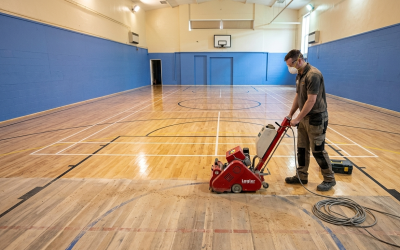
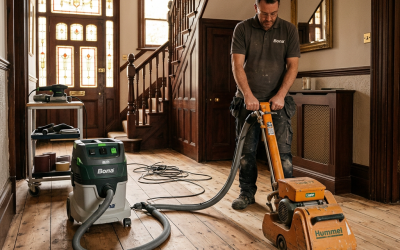
Sanding is not just a cosmetic buff. Done properly, it is a technical restoration process. A commercial floor sanding contractor will usually assess wear patterns, coating failure, localised damage, board movement, gaps, edge condition, previous repairs, and the likely performance of the new finish before work begins.
A full sanding and refinishing programme can address:
- Surface scratches, scuffs and traffic-lane dullness
- Old sealers, lacquers or oils that have broken down unevenly
- Light staining and ingrained dirt in worn finish layers
- Minor lipping or unevenness between adjacent boards
- Small gaps and isolated damaged sections
- A tired overall appearance that no longer suits the brand
Once the surface is properly prepared, the floor can be re-finished to suit the business. A matt lacquer may create a modern, low-glare look for a studio or office. A satin commercial coating may suit a shop or salon where durability and ease of cleaning matter most. For some interiors, a hardwax oil system can deliver a warmer, more natural presentation. The point is that sanding gives you options without forcing full replacement.
Acton businesses often benefit from the lower-disruption route
Downtime is one of the biggest commercial arguments in favour of sanding. A small independent business cannot always shut for a week or more without financial consequences. Even when closure is possible, the knock-on effect on bookings, deliveries, staff rotas and customer confidence can be significant.
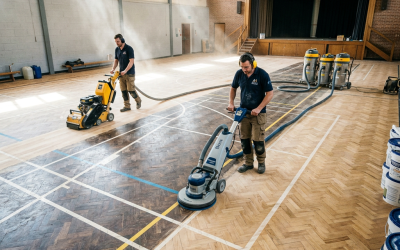
Professional restoration can often be phased more intelligently than replacement. Work can be scheduled in zones, out of hours, at weekends, or around lower-traffic periods. Dust-controlled machinery, careful masking and disciplined sequencing all help keep disruption manageable. That is especially important in mixed-use parts of Acton, where businesses may share entrances, upper floors, neighbouring retail frontage or restricted access points.
This is one reason commercial operators already exploring commercial floor sanding for business floors often discover that restoration is more practical than replacement. It keeps the project focused on performance and appearance rather than turning it into a more invasive refit.
Why sanding is often the better financial decision
The headline price of replacement rarely reflects the full commercial cost. Business owners naturally compare quotations, but the smarter comparison is total project cost rather than material supply alone.
When you replace a timber floor, the budget may include:
- Removal of the old boards or blocks
- Waste handling and disposal
- Subfloor repairs or levelling
- Moisture management or membrane work
- Supply of new timber
- Installation labour
- Finishing products
- Longer closure or restricted trading
With sanding, the structural floor is retained. That reduces material spend and usually shortens the programme. It also preserves capital for other improvements that customers actually see and interact with, such as lighting, signage, seating, joinery or merchandising. In other words, sanding often releases budget rather than swallowing it.
That matters for small businesses. If the existing floor can be stabilised, sanded and sealed to a high standard, replacement may not improve the commercial outcome enough to justify the additional spend. In many premises, the better return comes from restoring what is already there and specifying the right protective finish for ongoing wear.
The sustainability case is stronger too
More businesses now think carefully about unnecessary waste. Replacing a floor that can still be restored means ripping out usable timber, transporting waste away, bringing new material in, and increasing the embodied impact of the project. Sanding is usually the lower-waste route because it extends the life of the floor already in the building.
That is not just good from an environmental perspective. It also makes commercial sense. A floor that can be renewed rather than discarded is an asset. Restoration aligns with practical, long-life property maintenance rather than short-cycle replacement. For many Acton businesses, especially those wanting a more responsible fit-out story, this is another reason sanding wins.
Not every floor should be sanded—but many more can be than owners realise
A proper survey matters. There are cases where full or partial replacement is the right call, such as severe rot, extensive structural movement, major water damage, or timber that has already been sanded too many times. But many floors that look beyond saving are still viable restoration candidates.
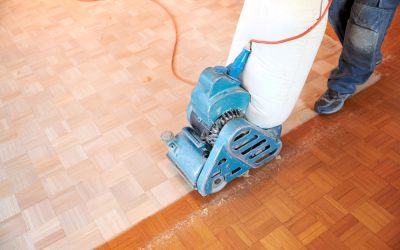
This is particularly true with older strip flooring, parquet, and solid timber boards found in period properties and long-established commercial units. Surface failure can look dramatic while the underlying timber remains serviceable. Even where isolated sections are too damaged, local repairs can sometimes be blended into a broader sanding programme so that only the genuinely failed areas are replaced.
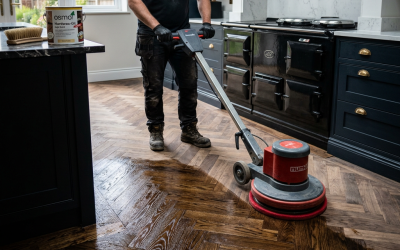
If your premises include timber blocks, it is worth understanding how restoration differs from replacement. Businesses with character interiors often gain more by preserving the original floor pattern than by installing something new and flatter in personality. That is why many owners researching Acton parquet floor restoration choose repair-and-refinish over wholesale uplift.
Finish specification is where long-term value is protected
The best investment decision is not just whether to sand, but how to finish the floor afterwards. The finish determines how well the restored surface handles footfall, cleaning, spills and day-to-day wear. For commercial premises, the wrong product can make a successful sanding job wear out faster than expected.
In higher-traffic settings, a professional-grade waterborne lacquer is often the safest choice because it combines clarity, durability and relatively fast return to service. Products in the Bona commercial range are widely specified where heavy wear resistance matters. For businesses wanting a more natural aesthetic, Osmo Polyx-Oil remains a popular hardwax option when the maintenance plan is realistic and the appearance suits the brand.
The important point is that a restored floor should not be finished like an afterthought. It should be specified according to real trading conditions: chair movement, customer traffic, cleaning frequency, entrance exposure, spill risk, and whether the space needs easy future recoating or localised repairability.
You can also review the broader service standards and local expertise available through Acton Floor Sanding if you are weighing how a commercial restoration project should be planned from survey to handover.
Common situations where sanding is usually the smarter choice
1. Retail units with surface wear but sound timber underneath
If the floor looks tired, patchy or scratched but remains stable, sanding can usually restore a clean sales-floor appearance far more efficiently than replacement.
2. Offices that need a brighter, more professional presentation
Many office floors are structurally fine but visually dull. Sanding and refinishing can modernise the space without the upheaval of fitting an entirely new floor system.
3. Salons, studios and treatment rooms
These spaces depend heavily on visual cleanliness. Restoring the timber often gives a sharper result than covering it or replacing it with a cheaper-looking alternative.
4. Cafés and hospitality spaces with character floors
Original boards and parquet can become part of the venue’s identity. Sanding preserves that character while improving durability and cleanability.
5. Businesses preparing to sell, re-let or reposition a unit
A professionally restored floor can make the premises look cared for and commercially ready without committing to the cost of full replacement.
When replacement may still be the better answer
A credible contractor should say when sanding is not enough. Replacement becomes more justifiable where:
- Moisture has caused widespread deformation or failure
- The timber is too thin or too compromised to refinish safely
- The floor has major structural instability
- Previous poor repairs have destroyed continuity across large areas
- A full redesign of levels, layout or floor type is required
Even then, the answer is not always full replacement throughout. In some commercial settings, a hybrid approach works better: targeted board replacement in failed zones, then sanding and sealing across the retained floor to create a consistent final result.
How to judge the decision properly
Before committing to either route, ask for a survey that covers more than appearance. A useful assessment should consider board thickness, wear layer where relevant, moisture readings, movement, subfloor condition, access constraints, likely downtime, repair strategy, and finish recommendations. If the discussion jumps straight to “replace it all” without a proper diagnosis, you may be being pushed toward the more expensive option rather than the most appropriate one.
It also helps to compare restoration against replacement on these six points:
- Total cost, not just material cost
- Downtime and lost trading risk
- Waste and disruption
- Visual outcome
- Maintenance burden after completion
- Expected lifespan before the next major intervention
In a surprising number of Acton commercial premises, sanding performs strongly on all six.
Do not overlook the value of future maintenance
A major reason sanding works so well as an investment is that it keeps future maintenance flexible. Once a timber floor has been restored and finished properly, it can often be maintained through periodic cleaning reviews, local touch-ins, and recoating at the right stage before full breakdown occurs. That is usually far cheaper than allowing the floor to deteriorate until replacement feels unavoidable.
Businesses dealing with mixed timber areas may also benefit from understanding how different constructions behave over time. If your premises include multiple timber formats, this guide to engineered vs solid wood floor refinishing and maintenance is useful background before planning longer-term upkeep.
Final verdict: smarter investment, less upheaval, stronger return
For many Acton small businesses, replacing a worn timber floor feels like the bold, permanent answer. Yet once you look past the first impression, sanding is often the more commercially intelligent move. It preserves usable material, reduces waste, shortens the programme, limits disruption, and delivers a finish that can dramatically improve the look of the premises. Most importantly, it does so without burdening the business with the broader cost and operational drag of full replacement.
If your existing floor is fundamentally sound, restoration is not the “cheap alternative”. It is often the professional choice. The smarter investment is usually the one that protects cash flow, keeps trading disruption under control, and turns an existing asset back into a feature.
For small businesses in W3, that often means sanding first, replacing only where it is genuinely necessary, and specifying the right finish system for the way the space is actually used.
Need expert advice on your commercial floor?
If your Acton shop, office, salon, café or studio has a timber floor that looks worn but may still be restorable, the best first step is a professional assessment. A proper survey can tell you whether sanding, repairs, recoating or selective replacement will give you the strongest result for the budget. For commercial spaces where appearance, durability and downtime all matter, informed restoration is often the route that makes the most sense.