School Floor Sanding in Acton, W3
School floor sanding in Acton, W3 requires more than a tidy finish and a fresh coat of lacquer. In busy classrooms, assembly halls, nurseries and school corridors, worn timber seals allow dirt, moisture and cleaning chemicals into the grain. Once the protective coating breaks down, boards become harder to sanitise, splinters develop around damaged edges, and smooth, contaminated surfaces can present a slipping risk.
At Acton Floor Sanding, we approach educational premises with the building’s daily operation in mind. Whether the job involves an ageing parquet hall off Acton High Street, a Victorian school conversion near Churchfield Road or a timber-floored teaching space around Acton Park, the first question is always the same: how can the floor be repaired properly without disrupting pupils, staff or the next morning’s opening?
Our approach to School Floor Restoration in Acton covers structural repairs, controlled sanding and specification of suitable protective finishes. We can also assess requirements for School Floor maintenance in Acton and School Floor Refinishing in Acton, where the timber remains sound enough to avoid unnecessary replacement.
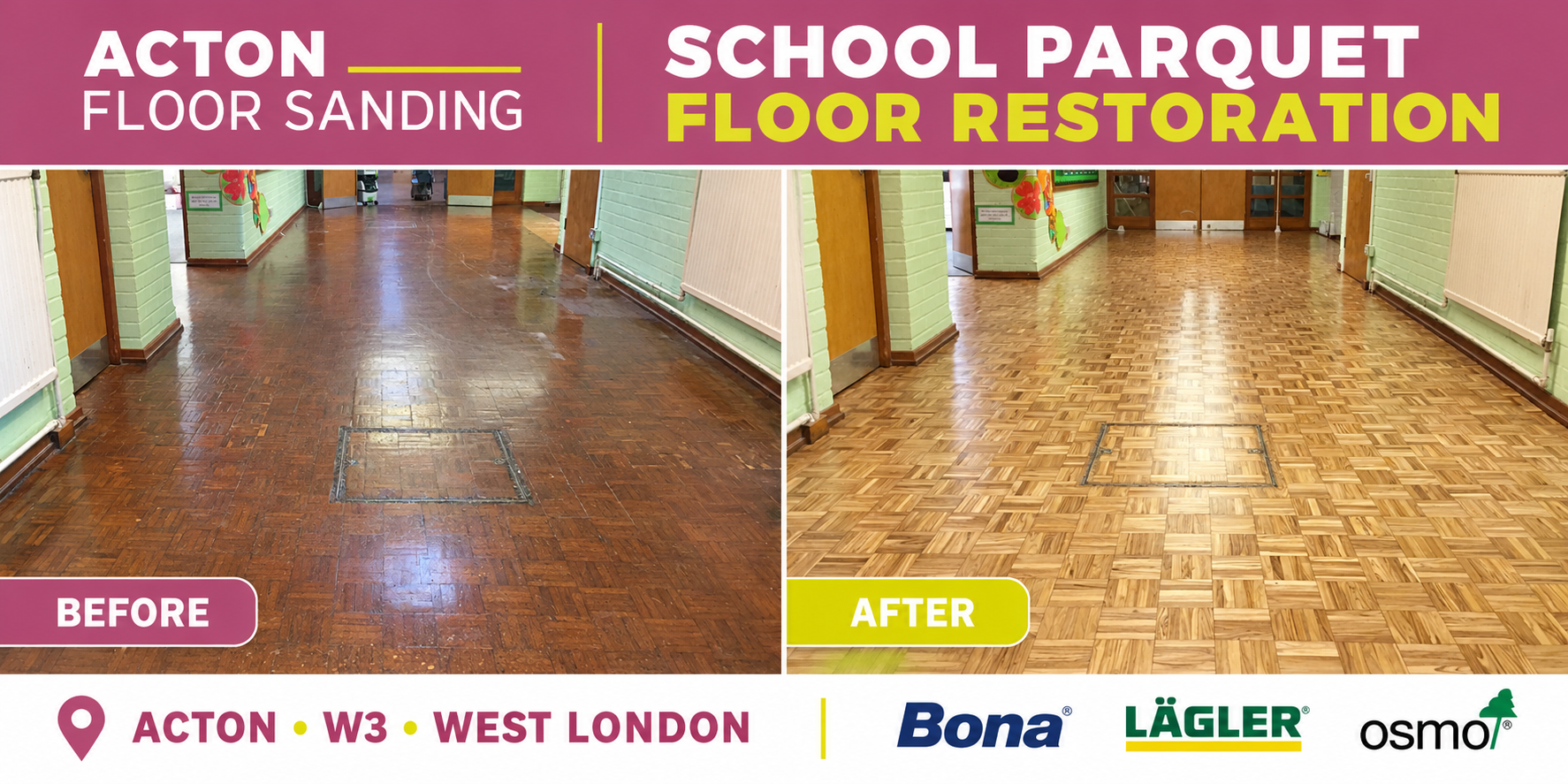
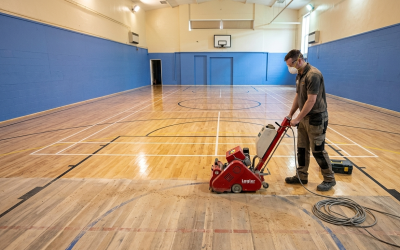
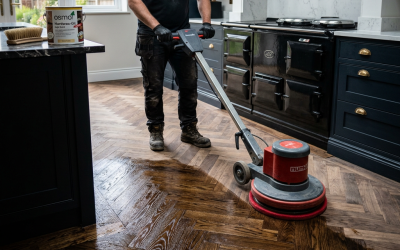
School floor sanding in Acton W3 – a before-and-after comparison showing the transformation of worn parquet flooring into a beautifully restored wooden school corridor.
Timber Floor Restoration for Schools, Nurseries and Educational Buildings
Educational floors suffer a particular type of wear. Hundreds of shoes follow the same routes between classrooms, dining areas and staircases, while tables, chair legs, sports equipment and cleaning machinery concentrate abrasion in predictable strips. A domestic floor finish may look acceptable on handover but be unsuitable for the cleaning frequency and traffic expected in a working school.
We assess timber flooring in primary and secondary schools, independent schools, academies, Montessori nurseries, preschools, special educational needs settings and sixth-form colleges. The same principles apply to university teaching rooms, adult learning centres, tuition academies, music schools, art studios, childcare centres and vocational training facilities, although the finish specification must reflect the use of each room.
Acton has a varied building stock. Around the Acton Town Centre Conservation Area, older institutional buildings and Victorian or Edwardian conversions can contain suspended timber floors, while later educational extensions may have parquet blocks laid over concrete. These constructions require different moisture checks, repair methods and sanding arrangements.
Why School Floors Deteriorate Faster Than Domestic Timber Flooring
A classroom or assembly hall cannot be treated like a household sitting room. Frequent damp mopping, concentrated disinfectants, abrasive dirt carried in from playgrounds and repeated furniture movement all shorten the life of a poorly specified coating. Applying supermarket polish over an exhausted lacquer film generally conceals the problem temporarily rather than repairing it.
During an initial survey, we concentrate on the defects that affect safety, cleaning and the remaining working life of the floor:
- Open board joints: Gaps collect food particles, dust, grit and cleaning residue, making routine hygiene work more difficult.
- Loose parquet blocks: Failed adhesives can allow individual fingers or blocks to rock underfoot, especially along heavily trafficked routes.
- Worn slip-resistant surfaces: Smooth lacquer, contamination and unsuitable cleaning products can affect the floor’s measured slip resistance.
- Moisture ingress: Leaking radiator valves, repeated wet cleaning and damp subfloors can encourage cupping, swelling and adhesive failure.
- Raised fixings and splinters: Exposed nail heads, damaged tongues and broken board edges are unacceptable in areas used by young children.
- Chemical deterioration: Aggressive detergents and incompatible cleaning treatments can soften, dull or damage protective coatings.
- Uneven historic repairs: Poorly matched replacement timber can leave lips and localised height differences that cannot simply be hidden under lacquer.
A proper restoration specification distinguishes surface wear from structural failure. If a board has lost its holding strength or a parquet section is moving, sanding alone will not make it serviceable.
Our Step-by-Step School Floor Sanding and Restoration Process
Step 1: Subfloor Audit, Timber Identification and Moisture Testing
We start by examining the floor construction, existing coating, previous repairs and remaining sanding depth. Older Acton buildings may contain pitch pine boards, oak strip flooring or oak parquet, while some specialist rooms contain teak or other dense hardwoods. Quartersawn oak, for example, generally behaves differently from flatsawn softwood when humidity changes.
Where parquet is bonded to a mineral subfloor, we check for signs of adhesive failure and investigate moisture using appropriate hygrometer or relative-humidity testing. Timber moisture readings are also taken where necessary, with results considered alongside room temperature, ventilation and the floor’s construction. A concrete slab that remains too damp for the proposed adhesive or finish must be dealt with before reinstatement.
We also check whether historic coatings, mastics or associated materials require specialist identification before disturbance. On older educational sites, any suspected asbestos-containing floor adhesive or bituminous residue must be assessed under the appropriate asbestos management arrangements; it is not something to attack with a sanding machine.
Step 2: Timber Repairs, Re-Bonding and Resin Gap-Filling
Loose parquet is lifted selectively where practical, the failed bonding material is assessed, and the blocks are cleaned and re-bonded with an adhesive compatible with the timber and subfloor. Modern silane-based flexible parquet adhesives can accommodate limited timber movement while providing dependable bond strength, provided the substrate and manufacturer’s application conditions are suitable.
For narrow, stable joints, a resin-slurry filler made with fine sanding dust can produce a close colour match. Wider gaps in old pitch pine boards may need fitted timber slivers rather than brittle filler, particularly where seasonal movement is expected. We do not recommend filling every joint on a suspended timber floor without considering ventilation and natural movement.
Broken boards, damaged parquet fingers and protruding metal fixings are repaired before machine sanding. Replacement material is chosen for species, dimensions and grain character, not simply because it resembles the original timber when newly cut.
Step 3: HEPA Dust-Controlled Sanding and Surface Preparation
For substantial timber floors, a Lägler Hummel belt sander provides the cutting control needed to remove old lacquer, embedded dirt and shallow surface damage. Edge sanding, corner preparation and intermediate abrasive stages follow, with the grit sequence adjusted to the timber species, coating and floor condition rather than using one standard setting for every room.
Dust management is particularly important around occupied educational buildings. The specification can include HEPA H14-filtered extraction, sealed work zones, suitable industrial vacuum cleaning and controlled material removal routes. H14 filtration is only effective as part of a properly selected, maintained and sealed extraction arrangement; a filter designation alone does not make the entire process dust-free.
Before coating, the surface is checked for machine marks, adhesive contamination and inconsistent absorption. Poor preparation becomes especially visible under low-angle daylight in long school corridors and large assembly halls.
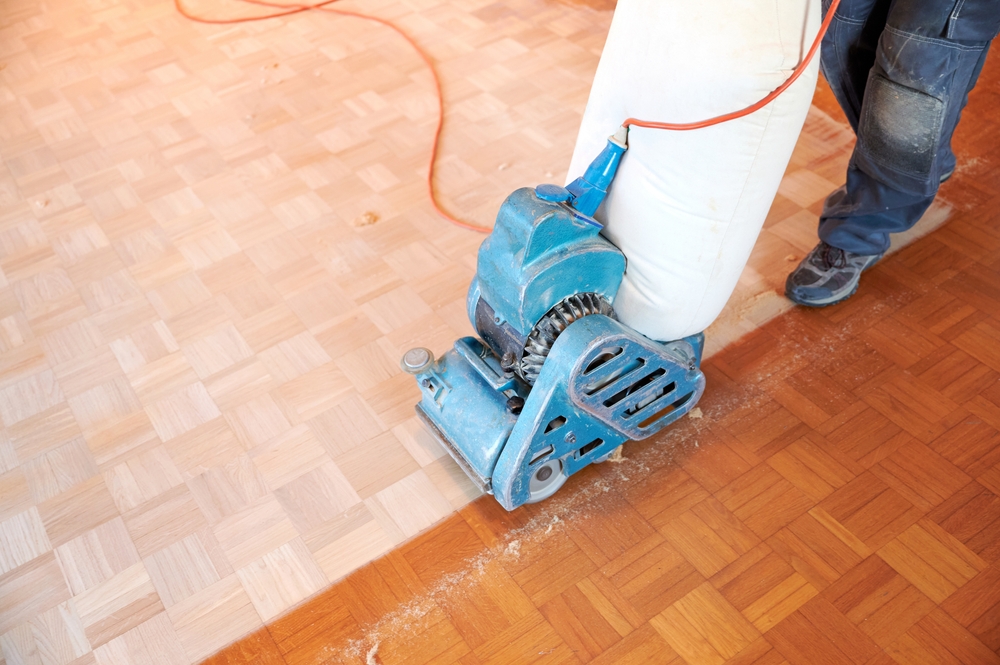
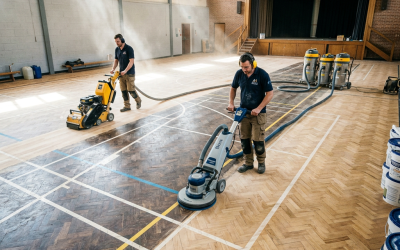
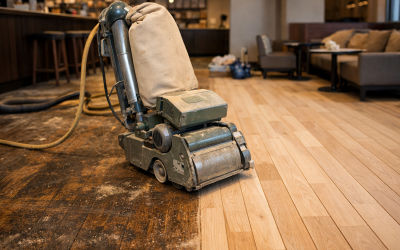
Expert school floor sanding in Acton W3, restoring worn parquet flooring to a smooth, clean finish using professional sanding equipment.
Step 4: High-Traffic Lacquers, Hardwax Oils and Anti-Slip Finishes
Finish selection depends on the room’s use, cleaning regime and acceptable closure period. For busy classrooms and corridors, two-component (2K) waterborne polyurethane lacquers are often appropriate because the cross-linking catalyst develops a tougher, chemically resistant film than a basic single-component coating.
One commercial example is Bona Traffic HD, a 2K waterborne timber floor lacquer developed for heavy traffic. Products must be assessed against their current technical data sheets, including compatibility, recoat intervals, emission classifications and safe-use requirements.
For selected teaching rooms or traditionally finished timber, Osmo Polyx-Oil provides a hardwax-oil alternative with a different appearance and maintenance method. It is not an automatic replacement for commercial lacquer in heavily trafficked corridors, and any oil finish must be assessed against expected wear, cleaning products and drying time.
Where slip resistance is a concern, an appropriate anti-slip lacquer system or compatible additive can be considered. Slip performance should be assessed using site-relevant pendulum testing, commonly associated with BS 7976-2 and the current BS EN 16165 framework. A Pendulum Test Value of 36 or above is generally classed as low slip potential under the tested conditions, but no coating should be described as universally slip-proof.
For indoor air quality, we review manufacturers’ VOC and emissions information, including recognised EMICODE EC1 Plus ratings where applicable to the specified product. EC1 Plus relates to very low emissions, not a blanket guarantee that all products are suitable for immediate occupation. COSHH assessments, ventilation and the specified curing period remain essential.
Step 5: Aftercare and School Floor Maintenance Protocols
The restoration is not complete until the caretaker or facilities team knows how to maintain the finish. Strong alkaline cleaners, excessive water and incompatible disinfectants can shorten coating life, even when the lacquer itself is designed for heavy commercial use.
We recommend a documented cleaning schedule using manufacturer-approved products, effective entrance matting, suitable chair-leg protection and prompt removal of grit. High-wear areas should be inspected routinely so that maintenance recoating can be considered before the protective film wears through to bare timber.
School halls and sports-use floors may require a separate inspection and maintenance specification, particularly where sports-floor friction, game-line markings or EN 14904 performance requirements apply.
Working Around School Hours, Safeguarding and Term-Time Restrictions
The main difficulty with school floor restoration is often access rather than sanding. A nursery may operate extended childcare hours, while a secondary school may have breakfast clubs, evening lettings, examinations or weekend sports bookings. These arrangements need to be understood before equipment arrives on site.
For Acton schools and education premises, the programme can be planned around INSET days, half-term closures, summer holidays, weekends or controlled out-of-hours access. Delivery arrangements, noise restrictions, alarm systems, fire exits, caretaker availability and segregation from occupied areas must be agreed in advance.
| Working Shift | Operational Benefits | Suitable Facilities |
|---|---|---|
| Overnight | Allows repair and sanding activity outside teaching hours, subject to noise controls, ventilation and sufficient coating cure time. | Tuition centres, colleges, administration rooms and selected school corridors. |
| Weekend Phased | Provides a longer uninterrupted window for sanding, coating, drying and inspection before reopening. | Primary schools, nurseries, academies, independent schools and teaching halls. |
| Sectional | Keeps unaffected rooms operational while individual zones are isolated and restored in sequence. | Larger campuses, universities, secondary schools and multi-room educational buildings. |
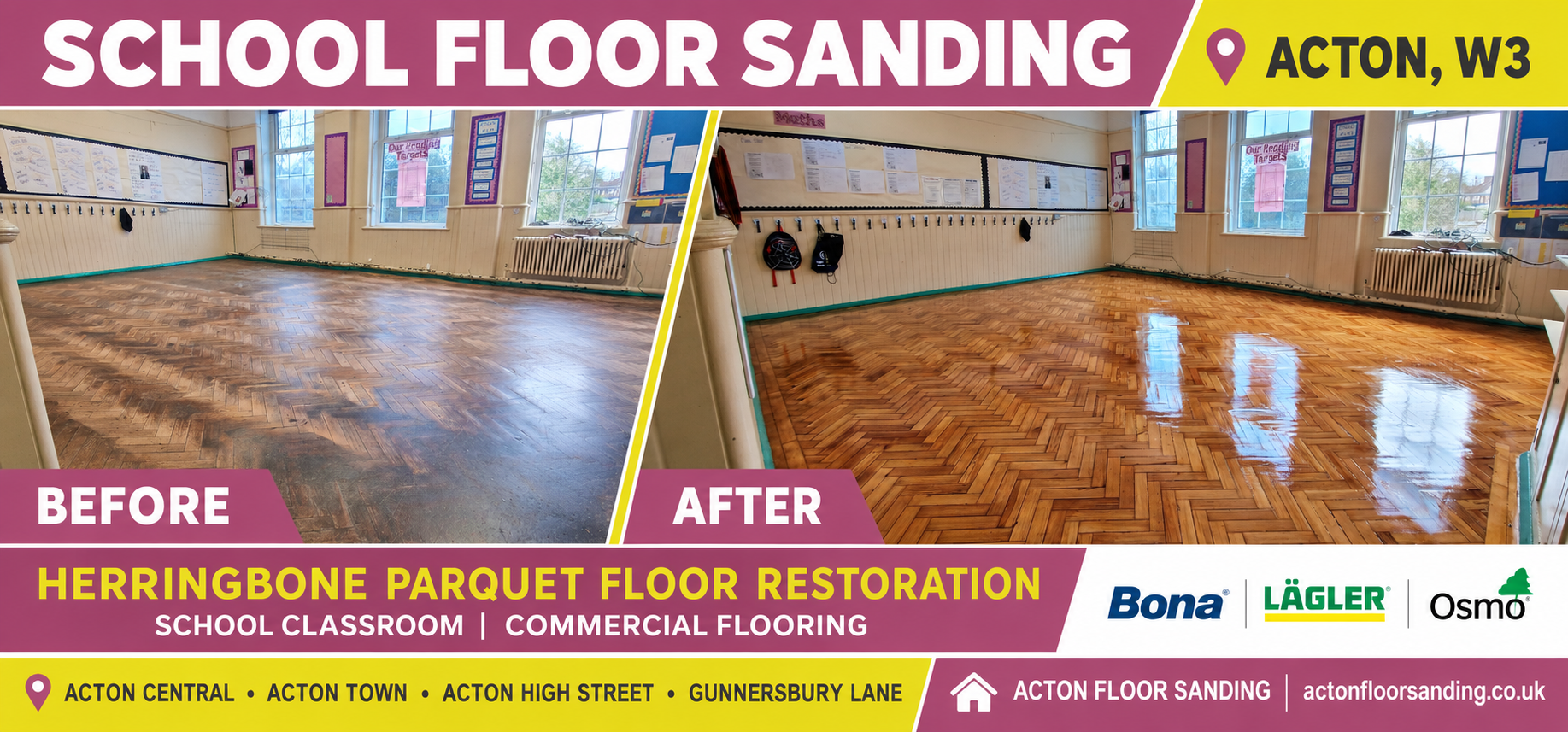
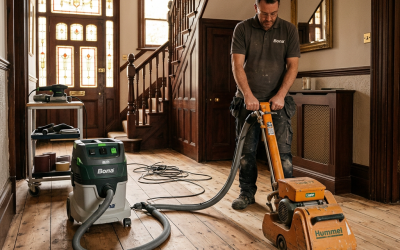
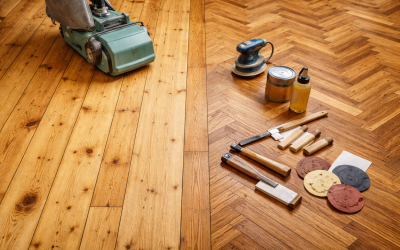
School floor sanding before and after in Acton, W3 – Professional herringbone parquet floor restoration for educational and commercial spaces by Acton Floor Sanding.
How Long Before Pupils Can Walk on the Floor?
Dry-to-touch, light foot traffic and full service are three different stages. Some rapid-cure commercial lacquers permit carefully controlled light use after approximately six hours and heavier use from around twelve hours under specified conditions, but these figures cannot be applied to every product or site.
Temperature, relative humidity, application thickness and ventilation can alter the programme. Desks, heavy furniture, protective coverings and repeated wet cleaning may need to remain off the surface considerably longer, with certain systems specifying several days before covering.
We would rather schedule an additional closure period than hand back a surface that is still too soft for furniture movement and a full school timetable. Reopening is based on the chosen finish’s technical requirements and actual site conditions, not simply the time shown on a calendar.
Health, Safety and Documentation for Educational Premises
A commercial school restoration job requires a proper site plan. Before work begins, the contractor’s RAMS (Risk Assessments and Method Statements), relevant COSHH documentation, dust management measures and emergency arrangements should be reviewed with the school or appointed principal contractor.
Safeguarding arrangements must be agreed with the designated school contact. This includes site induction, appropriate access restrictions, verification of personnel, and DBS checks where legally eligible and required by the nature of the work or school safeguarding policy. A CSCS card supports evidence of construction-site competence but does not replace safeguarding clearance or trade-specific training.
Other matters include public and employers’ liability insurance, safe storage of coating chemicals, electrical equipment checks, fire precautions, and control of sanding noise and airborne dust. Where independent slip testing is specified, results should identify the testing conditions and method rather than offering an unsupported claim of compliance.
School Floor Sanding Prices in Acton, W3
School floor sanding costs depend on the floor area, species, existing coating, repair requirements and access restrictions. A large, unobstructed hall may be more efficient to sand per square metre than several small classrooms containing fixed cupboards, awkward thresholds and extensive parquet repairs.
Our published floor sanding prices in Acton provide an initial guide, including sanding, finishing, commercial lacquer upgrades and gap-filling options. Educational projects should still be assessed individually, especially where out-of-hours working, specialist coatings, moisture treatment or phased handovers are necessary.
We recommend starting with photographs or a short video showing the whole room, the worst damaged areas and the junctions around doors and radiators. Floor plans and approximate measurements help with the initial estimate, followed by a physical survey where the scale or condition requires it.
See Floor Sanding and Restoration Examples
Before approving a school-floor refurbishment, it helps to understand the difference between superficial refinishing and a full sanding programme. Our floor restoration gallery provides examples of timber floor work and finishing results.
For your own site, ask for a sample area where necessary, particularly when restoring darkened pitch pine, old oak parquet or timber with several generations of previous coatings. A small test patch can reveal staining, colour variation and finish compatibility before the main floor is committed.
Why Careful Specification Matters on School Floors
School estates teams need a contractor who can explain the repair method, coating system and handover conditions in plain terms. The lowest sanding quotation is rarely good value if loose blocks are left in place or the finish fails under routine cleaning.
Our quotation approach is straightforward: establish the condition from photographs or video, arrange a site survey where needed, identify the repair and coating options, and define the proposed work schedule. The written quotation should distinguish included repairs, sanding stages, finishing products and any additional access or preparation costs.
Before appointment, facilities managers should request current commercial insurance evidence, the proposed team’s relevant CSCS card details where applicable, safeguarding documentation, RAMS and coating technical data sheets. These checks allow the school’s responsible person to confirm that the proposed arrangements are fit-for-purpose.
Whether the building is near Acton Central, Acton Town, the High Street or the streets around Gunnersbury Lane, the aim is a properly repaired timber surface that can withstand its intended educational use and be maintained without unnecessary expense.